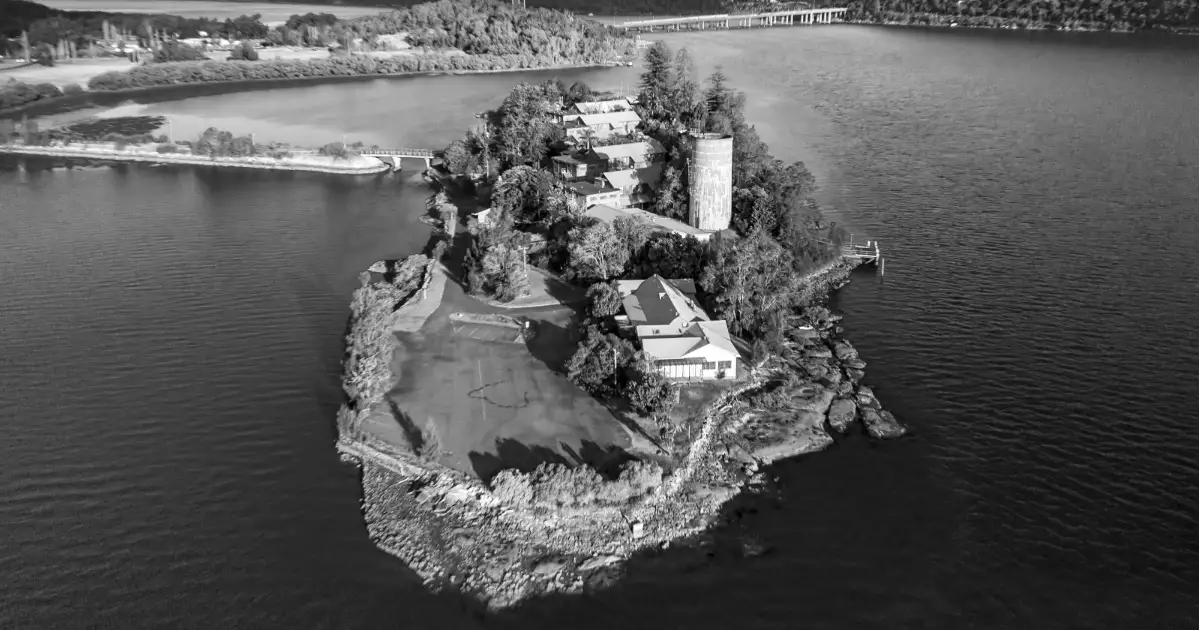
On the Hawkesbury River, just north of Sydney, sits an eight hectare island that most travellers glimpse only in passing. From the M1 it looks peaceful, framed by mangroves and quiet water. Yet for more than a century Peat Island carried a reputation so dark that families whispered its name and governments avoided its past. It was an institution built on isolation, secrecy and suffering, and its story remains one of the most haunting chapters in Australian social history.
An Island Built to Hide People
Peat Island opened in 1911 as an asylum for inebriates. Within years it was repurposed as a psychiatric hospital, a place where people with intellectual disabilities, learning difficulties and congenital conditions were sent. The island’s geography suited the era’s thinking. A guarded causeway separated it from the mainland village of Mooney Mooney. Water surrounded every boundary. Once admitted, many residents stayed for decades. Some arrived as children and lived out their entire lives behind cyclone fences and padlocked doors.
The institution grew into a world of its own. Staff lived on site. Supplies arrived by boat. Patients were kept out of sight and out of mind. Overcrowding became routine. Former visitors recalled dormitories packed with boys, some numbering in the hundreds, with an average tenure of forty five years. It was a place designed to contain people, not to help them.
Ward 4: The Heart of the Horror
Among the island’s wards, one became infamous. Ward 4 was described by doctors, journalists and former staff as the most brutal part of the institution. Its doors were heavily padlocked. The windows were covered in thick wire mesh. The smell of urine, faeces and vomit hit visitors the moment they entered. Patients rocked back and forth in constant motion. Others screamed, banged their heads or dragged themselves across the floor. Some were openly aggressive. Many were naked. It was, as one doctor wrote, One Flew Over the Cuckoo’s Nest in reality.
Dr Ted Freeman, who worked at Peat Island in 1981, wrote that Ward 4 was a prison. He described residents who had lived there for almost fifty years, many with post encephalitis or cerebral palsy, and others with no recorded medical history at all. Clinical notes focused on minor ailments rather than mental state or behaviour. There was no evidence of therapy. For the residents of Ward 4, he wrote, death was the only release.
Mysterious Deaths and Unanswered Questions
Over its years of operation Peat Island repeatedly made headlines for the deaths of child patients. The first widely reported case occurred in 1940 when eight year old Robert Bruce Walker was found floating in the Hawkesbury after being put in the pen, a caged compartment used as punishment. The hospital manager told the inquest that these patients were up to all sorts of tricks.
In 1950, eleven year old Robert Blackwood was found asphyxiated in an iron linen bin after only five months at the institution. Staff said he had been mischievous and playful and had died playing hide and seek among soiled laundry. Journalists who visited the island in the 1950s described it as a hospital of forgotten children.
Many other unexplained deaths occurred. At least three hundred patients, both adults and children, were buried in unmarked graves at nearby Brooklyn Cemetery. Families were often told their children had drowned. Investigations were rare. Records were incomplete. For some families, the truth never surfaced.
Benny’s Story
One of the most enduring mysteries is the death of Bernardus Reinders, known as Benny. He was institutionalised as a child in the early 1960s for learning difficulties. His brother Karl last saw him around the age of ten. One day Benny was there and the next he was gone. Five years later the family received a knock on the door telling them he had drowned.
Karl Reinders spent decades searching for answers. He questioned how a boy with learning difficulties could climb a six foot fence and reach the river. He discovered other cases of children who had drowned under similar circumstances. He asked for records. He hit brick walls. Benny’s death remained unexplained, one of many tragedies that shaped the island’s legacy.
Inside the Abandoned Buildings
After the institution closed, journalists and photographers who gained access found mementos scattered through darkened dormitories. The causeway was rusty and overgrown. The bridge led to boarded up buildings with beautiful river views that contrasted sharply with the suffering once contained within.
A 1950s swimming pool filled with brown water sat beside a broken fountain and an old children’s swing. In the Seabreeze dormitory, 1920s basins and lavatories lined stark rooms. Laundry pigeon holes still carried the names of former residents. Upstairs, small rooms the size of prison cells held shelves labelled for long pants, short sleeved shirts and shorts. Drawings of houses and people dotted the walls. An old classroom was covered in stickers and doodles beneath peeling paint.
In the Denby dormitory, mobiles and wind chimes hung from the ceiling. Posters of animals and houses remained pinned to the walls. Outside, palm trees framed a stunning view up the river, a reminder of the beauty that surrounded a place built on suffering.
Voices From the Past
Families and former visitors have shared memories that reveal the depth of the island’s trauma. Peter McMahon described visiting his brother Bernard, who had intellectual and physical disabilities, and seeing naked men screaming behind cyclone fences. He recalled an alcoholic doctor, severe overcrowding and the horror his brother felt each time he returned.
A blogger named Patricia wrote of visiting in 1973 and seeing men and boys caged in a concrete courtyard, naked, many masturbating. Staff hosed them down. She described residents in straight jackets, others over medicated, and younger residents who had been victims of sexual assault. Many carried their few possessions to prevent theft. They were given small amounts of money instead of their pensions.
The Final Years
By the late twentieth century attitudes toward disability care began to shift. In 1989 the island was transferred from the Department of Health to the Department of Community Services, and later to Ageing Disability and Home Care. Care improved. Staff worked to provide dignity and support. The last residents left in 2010.
Today Peat Island stands silent. Its Edwardian buildings are rusting and overgrown. Rabbits roam the grounds. The causeway remains closed to the public. The island’s beauty hides its past, but the stories endure. Peat Island is a place Australia should not forget. It is a reminder of how easily vulnerable people can be hidden away, and how important it is to remember those who lived and died behind its locked doors.